AI Agent Observability: What to Log, Audit, and Alert On in 2026
AI agent observability guide detailing what to log, audit, and alert on across autonomous workflows, MCP tools, tamper-evident hash chains, and kill switches.
Executive Summary: Autonomous Systems Demand Verifiable Governance
Most engineering teams do not fail with AI agents because Large Language Models cannot write Python or call APIs. They fail because they treat an autonomous agent as if it were a deterministic microservice. A microservice executes the exact lines of code committed to a repository; an agent reasons probabilistically, selects tools dynamically, generates parameters on the fly, and retries based on internal statistical weights.
When you grant an autonomous agent access to production infrastructure—such as video transcoding workers, CDN pull-zone caches, storage buckets, or DNS records—traditional Application Performance Monitoring (APM) tools go blind. A conventional monitoring tool tells you that an HTTP endpoint returned a 200 OK in 34 milliseconds. It cannot tell you what reasoning prompt persuaded the model to delete an asset, whether the agent checked its assigned permission boundaries before making the call, who authorized the mutation, or how to prove cryptographically that the audit log was not altered after an incident.
To operate autonomous agents safely in production, engineering organizations require a disciplined Autonomous Agent Observability Triad:
- What to Log: Ephemeral runtime telemetry capturing prompts, raw completions, tool invocations, token consumption, latency, and distributed OpenTelemetry spans for real-time debugging and model performance optimization.
- What to Audit: Cryptographically sealed, immutable audit ledgers capturing pre-action capability discovery, state mutations, human-in-the-loop approvals, cryptographic nonces, and SHA-256 hash chains for non-repudiation and compliance.
- What to Alert On: Real-time anomaly detection identifying runaway invocation loops, semantic drift, token velocity spikes, privilege escalation attempts, authorization challenge abandonments, and instant kill switch triggers.
This guide explains AI agent observability as production engineering teams operate it in 2026. Using Ollanode—an Apache-2.0 licensed, API-first video, CDN, storage, and edge platform with native AI agent governance primitives—as our reference architecture, we examine the telemetry schemas, cryptographic verification algorithms, Prometheus alert rules, and production runbooks necessary to maintain complete sovereignty over autonomous systems.
Quick Answer: What Is AI Agent Observability?
AI agent observability is the operational contract between probabilistic cognitive systems and deterministic infrastructure. Without logging, you cannot understand why the model acted; without auditing, you cannot prove what state changed; without alerting, an autonomous loop can destroy production before a human intervenes.
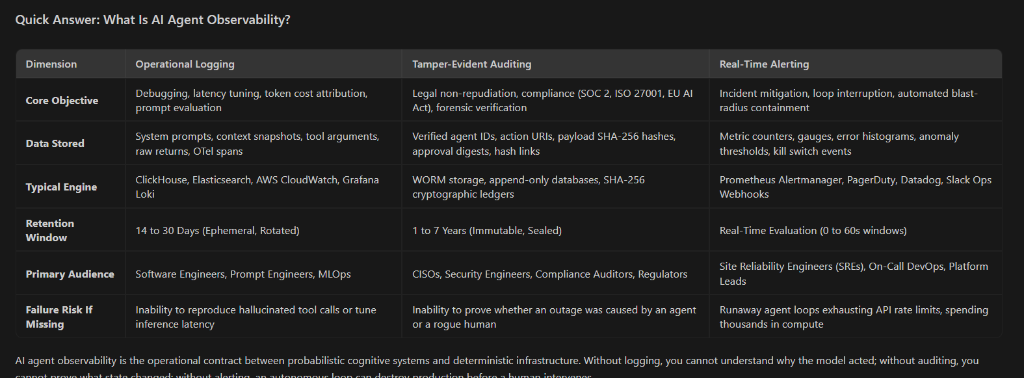
| Dimension | Operational Logging | Tamper-Evident Auditing | Real-Time Alerting |
|---|---|---|---|
| Core Objective | Debugging, latency tuning, token cost attribution, prompt evaluation | Legal non-repudiation, compliance (SOC 2, ISO 27001, EU AI Act), forensic verification | Incident mitigation, loop interruption, automated blast-radius containment |
| Data Stored | System prompts, context snapshots, tool arguments, raw returns, OTel spans | Verified agent IDs, action URIs, payload SHA-256 hashes, approval digests, hash links | Metric counters, gauges, error histograms, anomaly thresholds, kill switch events |
| Typical Engine | ClickHouse, Elasticsearch, AWS CloudWatch, Grafana Loki | WORM storage, append-only databases, SHA-256 cryptographic ledgers | Prometheus Alertmanager, PagerDuty, Datadog, Slack Ops Webhooks |
| Retention Window | 14 to 30 Days (Ephemeral, Rotated) | 1 to 7 Years (Immutable, Sealed) | Real-Time Evaluation (0 to 60s windows) |
| Primary Audience | Software Engineers, Prompt Engineers, MLOps | CISOs, Security Engineers, Compliance Auditors, Regulators | Site Reliability Engineers (SREs), On-Call DevOps, Platform Leads |
| Failure Risk If Missing | Inability to reproduce hallucinated tool calls or tune inference latency | Inability to prove whether an outage was caused by an agent or a rogue human | Runaway agent loops exhausting API rate limits, spending thousands in compute |
KEY TAKEAWAYS
- Operational Logs Are Not Audit Records: Logs are mutable, ephemeral, and optimized for high-volume text search. Audit records must be cryptographically immutable, bound to unique agent identities, structured with SHA-256 hash chains (
prev_hashtoentry_hash), and preserved in write-once-read-many (WORM) storage for non-repudiation. - Capture the Complete Tool Invocation Cycle: Recording only the model's final conversational text is useless for infrastructure debugging. Observability requires capturing the full turn: prompt context snapshot, tool discovery query, tool selection rationale, emitted JSON argument schema, raw tool execution return value, and downstream agent interpretation.
- Pre-Action Capability Discovery Must Precede Execution: Autonomous agents must query their assigned boundary prior to execution (such as Ollanode's
/v1/whoamiendpoint). The audit log must record whether the agent verified its capabilities or blindly attempted an unauthorized action. - Enforce Tri-Tier Action Boundaries: Infrastructure APIs exposed to agents must classify operations into three strict capability tiers: allowed (read-only queries and benign uploads that execute immediately), approval (state-mutating actions like purging CDN caches or deleting videos that return an HTTP 202 Accepted pending human cryptographic sign-off), and denied (hard-blocked administrative actions such as API key creation or billing alterations).
- Loop Detection Requires Semantic and Frequency Metrics: Static rate limiting cannot detect an agent trapped in a semantic retry loop. Production alerting must track identical tool argument hashes over sliding windows, rapid ping-pong transitions between dependent tools, and token consumption acceleration.
- Every Agent Must Have an Out-of-Band Kill Switch: Infrastructure control planes must expose an instantaneous, out-of-band kill switch (such as Ollanode's
/v1/admin/disable-agentsendpoint) that immediately revokes all active agent sessions, aborts in-flight operations, and rejects incoming tool calls at the API gateway without waiting for long-running LLM inference calls to finish.
1. Problem Statement: Why AI Agent Observability Became a Category
In 2026, autonomous software agents powered by Large Language Models and standardized via protocols like Anthropic’s Model Context Protocol (MCP) are no longer toy chatbots answering questions in browser tabs. In modern engineering organizations, AI agents operate directly against production control planes. They inspect video transcoding queues, provision Content Delivery Network (CDN) pull zones, optimize media storage tiers, reconfigure authoritative DNS records, trigger edge function deployments, and diagnose infrastructure incidents autonomously.
When a human software engineer interacts with infrastructure, organizations rely on established security and observability boundaries: identity providers (IdPs), Multi-Factor Authentication (MFA), role-based access control (RBAC), and centralized audit logs recording deterministic commands. When an autonomous AI agent interacts with infrastructure, those traditional assumptions collapse due to three operational realities:
Probabilistic Execution Replaces Deterministic Logic
Traditional services follow static control flows: if condition A, execute function B. An autonomous agent evaluates goals probabilistically. Given an instruction such as “optimize video transcoding queues for all media uploaded in the last 24 hours,” the model decides which tools to discover, what order to call them in, what arguments to generate, and how to recover from transient failures. If the agent misinterprets an API error or hallucinates a parameter, it can generate hundreds of syntactically valid but operationally catastrophic calls within seconds.
The Black-Box Reasoning Problem
When a traditional script crashes, the stack trace points directly to the line of code that failed. When an agent executes a destructive action—such as issuing a wildcard cache purge on a global CDN pull zone—the API server receives a valid, authenticated HTTP request. Traditional logs reveal that the purge happened, but they cannot explain why the model concluded that purging the entire edge cache was necessary, what prompt instructions influenced that decision, or which tool return output misled the model’s reasoning cycle.
The category of AI agent observability exists because managing autonomous systems requires visibility into both the cognitive reasoning layer (prompts, context, model weights) and the deterministic execution layer (APIs, parameters, state changes, hash chains).
2. A Short History: From Raw Prompt Logs to Cryptographic Governance
The evolution of agent observability mirrors the broader evolution of cloud infrastructure, moving from primitive scripts to structured platforms:
Phase 1: Raw Prompt Dumps (2023)
The earliest implementations routed raw prompt and completion strings into application loggers or flat text files. Developers grep’d through multiline text logs to see what the model said. These logs contained massive volumes of unstructured text, lacked correlation IDs, leaked sensitive customer data and API secrets, and provided zero visibility into external tool execution.
Phase 2: LLM Gateway Tracing (2024–2025)
As teams adopted structured tool calling, dedicated LLM gateways emerged. These tools introduced basic OpenTelemetry spans tracking model inference latency, prompt token counts, completion token costs, and raw JSON tool payloads. While sufficient for debugging simple chatbots, gateway tracing remained disconnected from downstream infrastructure: it could trace the HTTP call to the model provider, but had no insight into what happened inside the media pipeline, database, or CDN edge once the tool executed.
Phase 3: Cryptographic Agent Governance (2026)
In the modern era, agent observability is treated as a first-class control plane requirement. Protocols like MCP standardize tool discovery and invocation. Infrastructure platforms like Ollanode embed native governance primitives directly into their APIs: pre-flight capability discovery (/v1/whoami), tri-tier capability gating (allowed, approval, denied), cryptographic SHA-256 hash chains linking audit entries, and out-of-band administrative kill switches. Observability is no longer just about inspecting model latency; it is about guaranteeing provable, tamper-evident operational sovereignty.
3. Definition: AI Agent Observability
Definition: AI Agent Observability is the practice, architecture, and telemetry tooling required to capture, trace, audit, and evaluate the non-deterministic cognitive cycles and deterministic infrastructure mutations of autonomous software agents—providing real-time operational debugging, cryptographic proof of authorization, and automated anomaly containment.
What It Is
- A tri-part telemetry architecture separating ephemeral operational logs, immutable audit ledgers, and sub-second anomaly alerting.
- Continuous tracing of the complete Model Context Protocol (MCP) lifecycle across tool discovery, argument generation, execution, and return interpretation.
- A cryptographic chain of custody linking every state-mutating infrastructure operation to verified agent identities, capability checks, and human approvals.
- Real-time semantic analysis capable of identifying recursive decision loops, parameter drift, and token velocity spikes before budget or availability limits are breached.
- An out-of-band control mechanism ensuring that human operators can instantaneously revoke agent authority across all active infrastructure components.
What It Is Not
- Simply piping
stdoutfrom an LLM script into an Elasticsearch or CloudWatch log group. - Basic API rate limiting based solely on IP addresses or global request counts.
- Traditional APM dashboards tracking CPU, memory, and HTTP status codes without capturing context windows or tool argument semantics.
- A post-incident post-mortem tool that relies on mutable database tables that can be edited by system administrators.
- Marketing theater that claims an agent is “safe” simply because its system prompt includes the words “be careful and do not delete anything important.”
4. Architecture: The Three Layers That Must Work Together
Autonomous agent observability requires decoupling operational requirements into three distinct layers sharing a common identity and correlation spine:
+-------------------------------------------------------------------------------+
|                      AI AGENT RUNTIME & MCP CLIENT                            |
+---------------------------------------+---------------------------------------+
                                        |
      +---------------------------------+---------------------------------+
      |                                 |                                 |
      v                                 v                                 v
+-----------------------+   +-----------------------+   +-----------------------+
|  1. OPERATIONAL LOGS  |   | 2. AUDIT LEDGER (WORM)|   |  3. REAL-TIME ALERTS  |
|  - Prompts & Context  |   |  - SHA-256 Hash Chain |   |  - Anomaly Detectors  |
|  - MCP Tool Turns     |   |  - Capability Checks  |   |  - Loop Throttling    |
|  - Token Attribution  |   |  - Human Approvals    |   |  - Kill Switch        |
|  - OTel Spans         |   |  - Non-Repudiation    |   |  - Prometheus Alerts  |
|  Retention: 14-30d    |   |  Retention: 1-7 Years |   |  Evaluation: 0-60s    |
+-----------------------+   +-----------------------+   +-----------------------+
Layer 1: Operational Logging (Ephemeral, Deep, Searchable)
Operational logging captures the internal mechanics of the agent’s thought-action-observation cycle. It stores prompt templates, context snapshots, model hyperparameters, token consumption numbers, tool execution durations, and raw error messages. Because this stream produces massive data volume and may contain sensitive runtime context, it is stored in high-throughput engines (ClickHouse, Elasticsearch, Grafana Loki), subjected to automated secret scrubbing at ingest, and rotated automatically after 14 to 30 days.
Layer 2: Tamper-Evident Auditing (Immutable, Cryptographic, Permanent)
Auditing represents the legal and operational system of record. An audit entry is generated whenever an agent verifies its capabilities, attempts an API mutation, receives a human approval challenge, or executes a state change. Rather than storing conversational text, audit records store deterministic cryptographic artifacts: verified agent IDs, action URIs, payload SHA-256 hashes, approval challenge digests, and a cryptographic link to the preceding audit entry (prev_hash). This creates an immutable, append-only ledger preserved in write-once-read-many (WORM) storage for 1 to 7 years to satisfy regulatory compliance.
Layer 3: Real-Time Alerting (Sub-Second, Evaluative, Actionable)
Alerting operates on continuous metric streams derived from the logging and auditing pipelines. Instead of storing payloads, the alerting layer updates Prometheus counters, gauges, and latency histograms. Evaluators check sliding time windows (10 seconds to 60 seconds) for threat signatures: identical tool argument thrashing, token consumption acceleration, 403 Forbidden bursts on restricted endpoints, and hanging approval challenges. When an anomaly threshold is crossed, the alerting layer notifies on-call engineers via PagerDuty or triggers an automated kill switch.
5. Internal Working: Request Path vs Action Execution vs Audit Ledger
When an autonomous agent interacts with infrastructure, operations move across three asynchronous execution timelines:
1. Cognitive Evaluation Path (Milliseconds to Seconds)
- The agent receives a high-level goal from a user or automated schedule.
- The agent queries its assigned capability envelope via
GET /v1/whoami. - The agent sends context and tool schemas to the Large Language Model inference provider.
- The model emits a structured tool call with generated JSON arguments.
- The agent runtime validates the arguments against the tool’s JSON schema.
- The runtime emits an OpenTelemetry span capturing prompt tokens, completion tokens, model version, and tool arguments.
2. Action Execution Path (Synchronous Gateway Validation)
- The agent runtime dispatches the tool call to the infrastructure API gateway carrying W3C distributed tracing headers (
traceparent). - The API gateway validates the agent’s authentication token and extracts its unique
agent_id. - The gateway checks the requested route against the agent’s capability tier:
- If allowed: The gateway executes the mutation immediately and returns
200 OKor201 Created. - If approval: The gateway halts execution, persists a pending challenge state, and returns
202 Acceptedwith a cryptographic approval digest. - If denied: The gateway rejects the request immediately with
403 Forbiddenand increments security threat counters.
- If allowed: The gateway executes the mutation immediately and returns
- If an approval challenge was returned, execution pauses until an authorized human administrator reviews the digest and submits a cryptographic sign-off.
3. Audit Ledger Commitment (Cryptographic Append-Only)
- The control plane constructs a canonical representation of the action:
entry_id,timestamp, previous record hash (prev_hash),agent_id,action route,target resource, andpayload SHA-256 hash. - The engine computes the new record hash: $$\text{entry_hash} = \text{SHA256}(\text{canonical_string})$$
- The audit record is committed to the append-only ledger and replicated to immutable WORM storage.
- Prometheus metrics are updated synchronously: tool call counters increment, token usage gauges adjust, and latency histograms record execution duration.
6. Layer 1 — Operational Logging
Operational logging captures high-frequency runtime telemetry to debug model reasoning, isolate tool failures, optimize latency, and attribute token costs.
1. The Model Context Protocol (MCP) Telemetry Lifecycle
Observability hooks must instrument four discrete moments in the MCP execution lifecycle:
tools/listCapture: Logs all tools, descriptions, and JSON schemas advertised to the agent at startup, proving what capabilities the model saw.tools/callInvocation: Records the tool name, unique call ID, timestamp, and the raw JSON arguments generated by the model before execution.- Execution Spans: Measures sub-second runtime latency, worker host metrics, child process status, and network egress calls.
tools/callResult: Records the raw return payload returned to the model, byte size, and whether the tool emitted an error (isError: true).
2. Context Fingerprinting & Token Accounting
Because LLMs do not maintain internal state, reproducing hallucinated calls requires reconstructing the exact context window:
- Prompt Fingerprint: SHA-256 hash and version ID of the system prompt (e.g.,
sysprompt_v2.4_transcode_supervisor). - Context Depth: Total conversational turn count at the time of invocation.
- Token Attribution: Granular metrics tracking prompt tokens, completion tokens, cache-read tokens, and estimated task cost in USD.
- Model Metadata: Explicit provider model string, temperature, and maximum token ceiling.
3. Distributed Tracing (W3C traceparent)
To link cognitive model turns with downstream cloud infrastructure, the agent runtime injects standard W3C traceparent headers into every HTTP request:
POST /v1/videos/vid_01J8N8Z4K/transcode HTTP/1.1
Host: api.ollanode.com
Authorization: Bearer agent_sec_9941a82f...
traceparent: 00-4bf92f3577b34da6a3ce929d0e0e4736-00f067aa0ba902b7-01
X-Ollanode-Agent-Id: agent_transcode_optimizer_prod
X-Ollanode-Task-Id: task_sync_hls_ladders_48h
This allows SREs to trace an operation end-to-end: root LLM inference span → MCP tool execution span → Ollanode API gateway → NATS transcode worker fleet.
7. Layer 2 — Tamper-Evident Auditing
Operational logs track runtime debugging; audit ledgers provide cryptographic non-repudiation proving what an agent changed, what permissions it possessed, and that the record was not altered post-incident.
The Problem with Standard Database Logs
Standard database logs fail for autonomous systems because:
- They are mutable: Any admin or compromised service account can run
UPDATEorDELETEon audit rows. - They lack causality: They record an API call occurred, but not whether the agent checked its boundary or passed cryptographic challenge verification.
1. Ollanode’s Tri-Tier Action Matrix
Endpoints are strictly segregated into three immutable capability tiers:
allowed(Immediate): Read-only telemetry, queue status (GET /v1/videos). Executes immediately with200 OK; logs a standard audit record.approval(Gated): State-mutating actions (asset deletion, CDN cache purges, DNS edits). Pauses execution with202 Acceptedand generates an HMAC Approval Challenge Digest requiring human sign-off.denied(Hard-Blocked): Administrative operations (API key generation, billing alters). Blocked with403 Forbidden; revokes the agent session and pages security.
2. Pre-Flight Boundary Discovery (GET /v1/whoami)
Agents must query /v1/whoami at startup. The API returns a machine-readable capability envelope defining permitted endpoints:
{
  "agent_id": "agent_transcode_optimizer_prod",
  "tier_matrix": {
    "allowed": ["GET /v1/videos", "GET /v1/queue/status"],
    "approval": ["POST /v1/videos/*/transcode", "DELETE /v1/videos/*", "POST /v1/cdn/purge"],
    "denied": ["POST /v1/api-keys", "PUT /v1/billing/*"]
  },
  "constraints": { "max_actions_per_minute": 30 }
}
This pre-flight check is recorded in the audit chain to prove the agent received explicit notice of its operational boundary.
3. SHA-256 Hash Chaining (prev_hash to entry_hash)
Every audit entry is cryptographically linked to the preceding record, creating a tamper-evident append-only ledger:
$$\text{entry_hash} = \text{SHA256}(\text{entry_id} \parallel \text{timestamp} \parallel \text{prev_hash} \parallel \text{agent_id} \parallel \text{action} \parallel \text{resource_uri} \parallel \text{payload_sha256} \parallel \text{status} \parallel \text{nonce})$$
- Genesis Record:
entry_id: 1uses aprev_hashof 64 zeros. - Tamper Evidence: Modifying any historical record invalidates its
entry_hash, breaking all subsequentprev_hashlinks across the entire ledger.
8. Layer 3 — Real-Time Alerting and Automated Blast-Radius Containment
Operational logs and audit ledgers provide historical forensics, but runaway agent loops demand sub-second mitigation. SRE teams must wire six critical threat signals directly into alerting pipelines:
The 6 Critical Anomaly Signatures & Thresholds
-
Runaway Invocation Loops
- The Threat: The agent gets trapped in a semantic retry loop, repeatedly calling the same tool without making progress.
- Telemetry & Threshold: Same tool invoked with identical argument hashes 4 or more times in 60 seconds (Warning), or 8 or more times in 120 seconds (Critical).
- Automated Containment: Dynamically throttle execution concurrency and alert the on-call SRE.
-
Token Velocity Surges
- The Threat: Prompt injection, context-window runaway, or reasoning loops burn massive tokens, causing billing shocks.
- Telemetry & Threshold: Consumption exceeding 1,000 tokens per second or surging 300% above the 7-day baseline.
- Automated Containment: Enforce a strict
max_tokenslimit of 4,096 and pause the agent run.
-
Privilege Escalation Bursts
- The Threat: The agent attempts to probe unauthorized routes or unassigned tenant boundaries.
- Telemetry & Threshold: A single 403 Forbidden on any denied-tier route, or more than 3 403s on any route within 5 minutes.
- Automated Containment: Instantly revoke the agent’s active session token and trigger an immediate Sev-1 security page.
-
Hanging 202 Approvals
- The Threat: The agent triggers a high-risk operation, receives an HTTP 202 challenge, and hangs or abandons the task.
- Telemetry & Threshold: Pending approval challenge unacted upon for more than 15 minutes.
- Automated Containment: Alert human reviewers; automatically expire the challenge after 60 minutes with an
APPROVAL_TIMEOUTaudit entry.
-
Schema Parameter Drift
- The Threat: The model hallucinates invalid argument fields that fail JSON schema validation.
- Telemetry & Threshold: Validation error rate (
isError: trueor 400 Bad Request) exceeding 10% of total tool calls over a 10-minute window. - Automated Containment: Flag model degradation or schema mismatch; temporarily suspend tool access.
-
Emergency Kill Switch Activation
- The Threat: Malicious behavior or systemic loop requires complete, immediate shutdown.
- Telemetry & Threshold: Control plane event
agent.killswitch.activatedtriggered viaPOST /v1/admin/disable-agents. - Automated Containment: Broadcast critical alert, invalidate all active agent JWTs and Redis locks, and drop in-flight tasks immediately.
9. End-to-End Workflow: From Autonomous Goal to Verified Mutation
To understand how logging, auditing, and alerting coordinate during a live operation, consider an autonomous optimization workflow executed against Ollanode:
- Goal Ingestion: An automated orchestrator assigns a task to
agent_transcode_optimizer_prod: “Review all video assets uploaded during the last 24 hours. If any 1080p source video lacks a 360p mobile rendition, generate the missing rendition.” - Capability Pre-Flight: The agent issues an authenticated
GET /v1/whoamirequest. The gateway verifies the agent’s credentials and returns its capability matrix. The call is logged to operational telemetry and recorded in the audit ledger. - Telemetry Span Initialization: The agent runner starts an OpenTelemetry root span
task_sync_hls_ladders_48hand injects the W3Ctraceparentcontext into its local environment. - Read-Only Inspection (
allowed): The agent invokesGET /v1/videos?since=24h. The gateway validates thatGET /v1/videosis in the allowed tier and returns the asset array immediately with200 OK. The operational logger records prompt tokens and completion latency. - Mutation Request (
approval): The agent discovers videovid_01J8N8Z4Kmissing a 360p rung. It issuesPOST /v1/videos/vid_01J8N8Z4K/transcodewith payload{"ladder": ["360p"]}. - Approval Gate Engagement: The gateway recognizes that video transcoding is in the approval tier. It pauses the request, generates an HMAC-SHA256 Approval Challenge Digest, and returns HTTP 202 Accepted. An audit entry
APPROVAL_PENDINGis committed to the hash chain. - Human Notification & Review: Ollanode dispatches a webhook to the engineering team’s Slack channel. An on-call engineer reviews the diff, confirms the target video ID and payload hash, and signs the digest via the Ollanode admin console.
10. Configuration Patterns That Matter
Production agent governance requires four foundational configuration patterns:
1. Capability Pre-Flight Discovery (GET /v1/whoami)
Before generating tool calls, the agent must query its permitted operational envelope to prevent 403 Forbidden errors and unauthorized probes:
// Query /v1/whoami to discover allowed, approval, and denied route sets
let capabilities: CapabilityMap = client
    .get(format!("{}/v1/whoami", api_base_url))
    .bearer_auth(agent_token)
    .header("X-Ollanode-Client", "agent-runtime-v1")
    .send().await?
    .json().await?;

// Enforce local checks: abort before calling endpoints not in `allowed` or `approval`
assert!(capabilities.tier_matrix.allowed.contains("GET /v1/videos"));
2. OpenTelemetry Tracing Wrapper for MCP Tool Calls
Every Model Context Protocol (MCP) tool execution must be wrapped in an OpenTelemetry span that captures the invocation arguments, latency, and downstream error state:
// Wrap MCP execution in an OpenTelemetry tracing span
let tool_span = tracing::info_span!(
    "mcp.tool.execution",
    tool.name = "trigger_video_transcode",
    agent.id = "agent_transcode_optimizer_prod",
    trace.id = %trace_id
);
let _enter = tool_span.enter();
let start = std::time::Instant::now();
let result = execute_tool_logic(arguments).await;
tracing::info!(duration_ms = start.elapsed().as_millis(), status = result.is_ok());
3. Cryptographic Hash Chaining (prev_hash to entry_hash)
Every state change appends a canonical audit record cryptographically linked via SHA-256 to the preceding record:
// Link new audit entry to preceding hash: entry_hash = SHA256(canonical_fields)
let canonical = format!(
    "{}|{}|{}|{}|{}|{}|{}|{}|{}",
    entry_id, timestamp, prev_hash, agent_id, action, resource_uri, payload_sha256, status, nonce
);
let entry_hash = hex::encode(sha2::Sha256::digest(canonical.as_bytes()));
If any historical row is modified, entry_hash changes and invalidates the entire downstream chain.
11. Practical Examples
Example A — Autonomous VOD Ladder Reconfiguration
- Scenario: An agent evaluates playback QoS analytics and detects high rebuffer rates on mobile networks in Southeast Asia. It determines that video masters require an additional 480p HLS rendition with a 600 kbps bitrate ceiling.
- Observability Posture:
GET /v1/videos/vid_8912/analyticsis in the allowed tier; executes immediately and records prompt tokens in the operational log.POST /v1/videos/vid_8912/ladderis in the approval tier; the gateway returns HTTP 202 Accepted with an Approval Challenge Digest.- The SRE reviews the suggested ladder parameters, approves the digest, and the transcode job is dispatched.
- The audit ledger records the pre-flight capability check, the challenge digest, and the human approver’s cryptographic signature.
Example B — Emergency CDN Pull-Zone Cache Invalidation
- Scenario: A defective video banner was inadvertently published to a high-traffic news portal. An incident response agent is triggered to flush the cache.
- Observability Posture:
- The agent attempts
POST /v1/cdn/purgewith payload{"path": "/*"}. - Because
/*affects the global cache, the gateway flags the wildcard as high-risk and enforces an approval challenge. - Alerting evaluators detect a wildcard purge request from an agent and page the on-call engineer.
- If the agent attempts to repeat the call rapidly, loop detection throttles the session automatically.
- The agent attempts
12. Performance Considerations
Telemetry Overhead vs Model Inference Latency
Engineering teams often worry about the latency added by cryptographic hash chaining, distributed tracing, and audit logging. In practice, cognitive LLM inference latency dwarfs telemetry overhead:
- LLM Inference Latency: 800ms to 4,000ms per conversational turn.
- SHA-256 Hash Computation: Less than 5 microseconds (0.005ms) in Rust or Go.
- OpenTelemetry Span Emission: Asynchronous UDP/gRPC batch export introduces zero blocking latency to the execution thread.
- Audit Ledger Write: Appending an audit record to an append-only WAL or database table takes 1ms to 3ms.
The total performance overhead of the complete observability stack accounts for less than 0.1% of the agent’s total turn duration.
Operational Log Ingest Sizing
Because operational logs capture context windows and tool arguments, high-concurrency agent clusters can produce significant log volume. Sizing rules:
- Average operational log record size: 2 KB to 8 KB per tool invocation.
- At 100 tool calls per minute, an agent cluster generates ~400 MB to 1.6 GB of raw log data daily.
- Apply automated log rotation with a 14-day retention window on ClickHouse or Elasticsearch to prevent runaway disk growth.
Audit Ledger Immutability Sizing
Audit records are compact because they store cryptographic hashes rather than raw conversational context:
- Average audit record size: ~450 bytes per entry.
- At 10,000 audit events per day, the annual storage footprint is ~1.6 GB.
- Long-term WORM archival costs (e.g., S3 Glacier or Object Lock) remain virtually negligible while providing bulletproof compliance.
13. Security Model
Deploying autonomous agents against infrastructure APIs requires defense-in-depth:
1. Ephemeral Agent Credentials
Never provision agents with long-lived static API keys. Agents must authenticate via short-lived JSON Web Tokens (JWTs) or mutual TLS (mTLS) certificates with explicit expiration leases (typically 1 to 4 hours). Tokens must be tied to specific project IDs and scoped strictly to the agent’s role.
2. Secret and PII Redaction at the Ingest Boundary
Autonomous agents frequently pass database passwords, API credentials, and customer personal data through prompt context and tool parameters. If persisted in plain text, organizations violate SOC 2, HIPAA, and GDPR standards:
- Implement regex and named-entity-recognition (NER) filters in the logging middleware to redact sensitive keys (
AKIA...,Bearer ..., credit card numbers) before logs are written to disk. - Store only the SHA-256 hash of request payloads (
payload_sha256) in the audit ledger, allowing verification without exposing sensitive cleartext.
3. WORM Storage Archival
Audit records must be replicated to Write-Once-Read-Many (WORM) storage (such as AWS S3 Object Lock in Compliance Mode or Ceph/MinIO immutable buckets). Once written, no administrative account—including root cloud accounts—can modify or delete records until the legal retention period has elapsed.
4. Independent Public Anchoring
To prove non-repudiation in court or regulatory audits, compute the terminal entry_hash of each day’s audit ledger and anchor it to a public RFC 3161 Time Stamping Authority or public blockchain ledger. This proves that the audit records existed in that exact state on that specific date, making post-facto tampering mathematically impossible.
14. Troubleshooting Reference
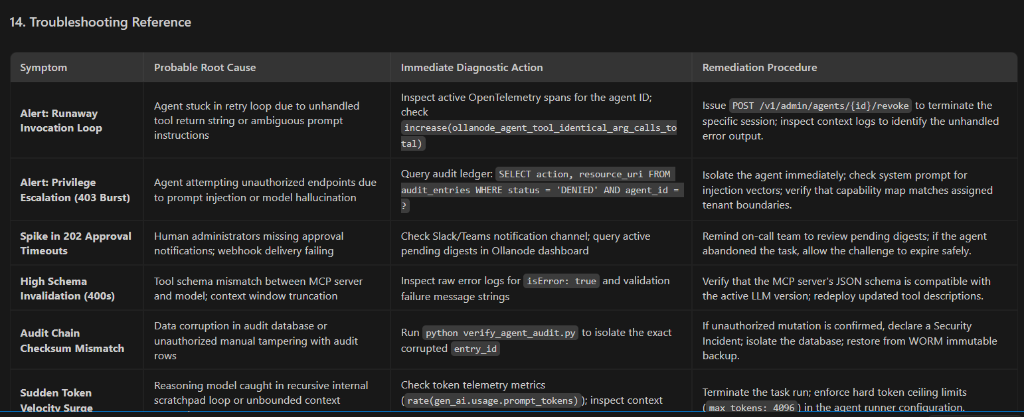
| Symptom | Probable Root Cause | Immediate Diagnostic Action | Remediation Procedure |
|---|---|---|---|
| Alert: Runaway Invocation Loop | Agent stuck in retry loop due to unhandled tool return string or ambiguous prompt instructions | Inspect active OpenTelemetry spans for the agent ID; check increase(ollanode_agent_tool_identical_arg_calls_total) | Issue POST /v1/admin/agents/{id}/revoke to terminate the specific session; inspect context logs to identify the unhandled error output. |
| Alert: Privilege Escalation (403 Burst) | Agent attempting unauthorized endpoints due to prompt injection or model hallucination | Query audit ledger: SELECT action, resource_uri FROM audit_entries WHERE status = 'DENIED' AND agent_id = ? | Isolate the agent immediately; check system prompt for injection vectors; verify that capability map matches assigned tenant boundaries. |
| Spike in 202 Approval Timeouts | Human administrators missing approval notifications; webhook delivery failing | Check Slack/Teams notification channel; query active pending digests in Ollanode dashboard | Remind on-call team to review pending digests; if the agent abandoned the task, allow the challenge to expire safely. |
| High Schema Invalidation (400s) | Tool schema mismatch between MCP server and model; context window truncation | Inspect raw error logs for isError: true and validation failure message strings | Verify that the MCP server’s JSON schema is compatible with the active LLM version; redeploy updated tool descriptions. |
| Audit Chain Checksum Mismatch | Data corruption in audit database or unauthorized manual tampering with audit rows | Run python verify_agent_audit.py to isolate the exact corrupted entry_id | If unauthorized mutation is confirmed, declare a Security Incident; isolate the database; restore from WORM immutable backup. |
| Sudden Token Velocity Surge | Reasoning model caught in recursive internal scratchpad loop or unbounded context | Check token telemetry metrics (rate(gen_ai.usage.prompt_tokens)); inspect context | Terminate the task run; enforce hard token ceiling limits (max_tokens: 4096) in the agent runner configuration. |
15. Best Practices
- Decouple Logging, Auditing, and Alerting: Store high-volume debug logs in rotated search stores (14–30 days), compliance records in immutable WORM ledgers (1–7 years), and anomaly metrics in real-time time-series databases.
- Mandate Pre-Flight Capability Discovery: Require all agents to query
/v1/whoamiupon session initialization. Log this check to prove the agent was aware of its boundaries. - Classify Every Endpoint into Tri-Tier Boundaries: Group infrastructure routes into allowed (immediate), approval (HTTP 202 pending human sign-off), and denied (hard-blocked).
- Implement Cryptographic Hash Chaining: Link audit records via SHA-256 (
prev_hashtoentry_hash) so any tampering or deletion is instantly detectable. - Bind Approval Challenges with HMAC Digests: Include the SHA-256 hash of the payload in the approval digest to prevent parameter tampering between approval and execution.
- Propagate W3C Trace Context: Inject
traceparentheaders across all MCP tool calls and API requests to achieve end-to-end distributed tracing from prompt to worker. - Deploy Semantic Loop Detection: Monitor identical tool argument hashes over 60-second sliding windows to catch recursive failure loops before rate limits are exhausted.
- Scrub Secrets at the Ingest Boundary: Strip bearer tokens, database passwords, and PII from prompts and tool arguments before persisting to disk.
16. Common Mistakes
- Treating Application Logs as Audit Ledgers: Application logs are mutable, lack cryptographic binding, and can be edited or deleted by database administrators.
- Logging Only Final Model Responses: Capturing only the agent’s final conversational message leaves engineers blind to intermediate tool choices, argument schemas, and execution errors.
- Granting Unrestricted API Keys: Giving an agent a broad administrative key under the assumption that the system prompt will constrain its actions violates least privilege.
- Relying Exclusively on Static Rate Limits: Agents in recursive loops can operate below rate limits (e.g., one call every 5 seconds) while causing severe operational damage.
- Ignoring Context Window Expansion: Allowing context windows to expand unbounded causes token velocity explosions and degrades reasoning quality.
- Permitting Unverified Approvals: Allowing human operators to approve actions without verifying the cryptographic payload hash allows subtle argument manipulation.
- Coupling Alerting to Text Search Queries: Running periodic regex searches against text log clusters introduces multi-minute alert delays during active incidents.
- Neglecting Ephemeral Credential Rotation: Using immortal API keys allows compromised agent credentials to persist indefinitely.
17. Alternatives and Comparison Tables
Observability Approach Comparison
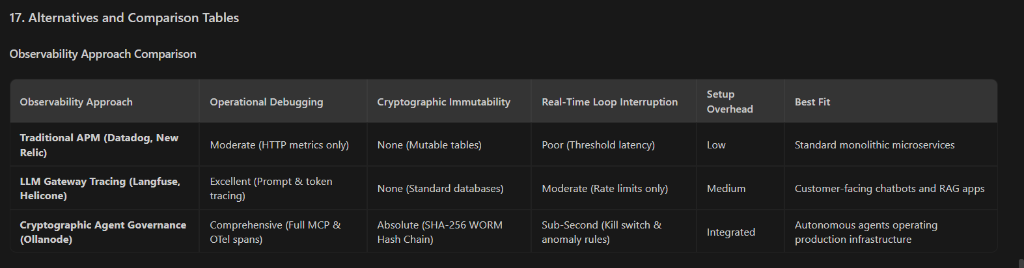
| Observability Approach | Operational Debugging | Cryptographic Immutability | Real-Time Loop Interruption | Setup Overhead | Best Fit |
|---|---|---|---|---|---|
| Traditional APM (Datadog, New Relic) | Moderate (HTTP metrics only) | None (Mutable tables) | Poor (Threshold latency) | Low | Standard monolithic microservices |
| LLM Gateway Tracing (Langfuse, Helicone) | Excellent (Prompt & token tracing) | None (Standard databases) | Moderate (Rate limits only) | Medium | Customer-facing chatbots and RAG apps |
| Cryptographic Agent Governance (Ollanode) | Comprehensive (Full MCP & OTel spans) | Absolute (SHA-256 WORM Hash Chain) | Sub-Second (Kill switch & anomaly rules) | Integrated | Autonomous agents operating production infrastructure |
Layer Completeness Checklist
| Architectural Capability | Raw Logging Scripts | LLM Gateway Tracing | Ollanode Agent Governance |
|---|---|---|---|
| OpenTelemetry GenAI Semantic Spans | No | Yes | Yes |
MCP Lifecycle Telemetry (tools/call) | Manual | Partial | Native |
Pre-Flight Capability Mapping (/v1/whoami) | No | No | Yes |
Tri-Tier Action Gating (allowed/approval/denied) | No | No | Yes |
| Cryptographic Hash Chain Audit Ledger | No | No | Yes (SHA-256) |
| HMAC Approval Digest Gating | No | No | Yes |
| Real-Time Semantic Loop Alerting | No | Partial | Yes (Prometheus) |
| Out-of-Band Administrative Kill Switch | Manual | Rare | Yes (/v1/admin/disable-agents) |
| Open Source License | Varies | Often Proprietary | Apache-2.0 |
18. Enterprise Deployment and Compliance
Deploying autonomous agents into regulated enterprise environments (healthcare, financial technology, enterprise media distribution) introduces rigorous legal compliance mandates:
SOC 2 Type II Compliance
- Common Criteria 6.1 & 6.2 (Logical Access & Least Privilege): Enforced via Ollanode’s pre-flight capability discovery (
/v1/whoami) and tri-tier action classification. - Common Criteria 7.2 (System Monitoring): Satisfied by Prometheus real-time anomaly alerting and OpenTelemetry distributed tracing.
- Common Criteria 7.3 (Incident Evaluation): Satisfied by the emergency out-of-band kill switch and automated session revocation.
EU AI Act (Articles 12, 13, and 14)
- Article 12 (Traceability & Record-Keeping): Requires high-risk AI systems to maintain automated logging over their entire lifecycle. Satisfied by Ollanode’s tamper-evident SHA-256 hash chains.
- Article 13 (Transparency): Requires that autonomous systems be interpretable by deployers. Satisfied by OpenTelemetry context snapshots and MCP tool discovery logs.
- Article 14 (Human Oversight): Requires that autonomous systems allow human intervention and overrides. Satisfied by the HTTP 202 Accepted human approval gate and the out-of-band kill switch.
ISO 27001:2022 Controls
- Control A.8.15 (Logging): Satisfied by decoupled operational logging with automated PII redaction.
- Control A.8.16 (Monitoring Activities): Satisfied by real-time Prometheus alerting for runaway loops and privilege escalation attempts.
- Control A.8.18 (Privileged Access Rights): Enforced by restricting all administrative mutations to human-in-the-loop cryptographic sign-offs.
19. Cloud and Hybrid Deployment
Autonomous agent observability can be deployed across various enterprise topologies:
Pattern 1 — Single-Region Cloud VPC
The agent runtime, Ollanode control plane, transcode workers, and telemetry clusters (ClickHouse, Prometheus, Grafana) run within a single cloud Virtual Private Cloud (VPC). Internal MCP tool calls travel over private subnets with mutual TLS. Audit ledgers replicate to regional S3 Object Lock buckets.
Pattern 2 — Hybrid Cloud & On-Premises
The agent runtime operates in a public cloud environment (e.g., utilizing hosted Claude or OpenAI inference endpoints), while the Ollanode control plane and media storage reside on-premises or in an air-gapped data center. All tool calls route through an Ollanode API gateway enforcing mTLS, /v1/whoami capability boundaries, and approval digest challenges before mutations touch local storage.
Pattern 3 — Air-Gapped High-Security Deployment
In defense, intelligence, or sovereign data environments, the complete stack—including local LLM inference engines (e.g., self-hosted Llama-3 or DeepSeek models via Ollama/vLLM), the Ollanode control plane, and the observability collectors—operates entirely offline with zero external internet connectivity. Audit ledgers are mirrored to local WORM-compliant storage arrays.
20. Frequently Asked Questions
1) What is the primary difference between AI agent observability and standard software APM?
Standard APM tools (such as Datadog, New Relic, or AWS CloudWatch) monitor deterministic software services. They record whether an endpoint responded with an HTTP 200 or 500, how much CPU and memory were consumed, and where latency occurred in the call stack. AI agent observability monitors non-deterministic cognitive systems. It explains why an agent chose a specific tool, what context and prompt instructions led to that choice, whether the action conformed to the agent’s permitted capability envelope, and provides cryptographic proof that the recorded action was authorized and unaltered.
2) Why should I use Model Context Protocol (MCP) instead of raw custom HTTP tool calls?
The Model Context Protocol (MCP) provides an open, standardized specification for how language models discover tools, inspect argument schemas, and execute operations across heterogeneous systems. Using MCP standardizes telemetry: your observability pipeline can implement a single telemetry wrapper that works across Claude, OpenAI models, Cursor, and internal agent runtimes, eliminating the need to write bespoke logging adapters for every new model provider.
3) How does Ollanode’s tri-tier capability model prevent catastrophic infrastructure outages?
By segregating endpoints into allowed, approval, and denied, Ollanode creates an architectural safety buffer. If an agent suffers a prompt injection attack or reasoning failure, it can only execute benign read operations autonomously. Any destructive or high-risk mutation (such as deleting a video archive, purging global CDN caches, or modifying DNS records) returns an HTTP 202 Accepted and halts execution until a verified human administrator inspects the exact cryptographic digest and approves it. Actions categorized as denied are physically blocked at the API gateway.
4) Can an agent bypass the 202 approval gate by modifying the payload after receiving the challenge?
No. The approval challenge digest is computed using an HMAC-SHA256 signature that incorporates the SHA-256 hash of the request payload body. When the human signs off on the approval, the control plane re-computes the payload hash from the incoming execution call. If even a single byte or character of the payload was altered between the challenge generation and release, the checksum check fails and the request is aborted immediately.
5) Why are static rate limits insufficient for detecting runaway agent loops?
Static rate limits (e.g., maximum 100 requests per minute) only protect against crude Denial of Service (DoS) floods. An agent trapped in a semantic loop can make 1 request every 5 seconds—well below standard rate limits—while executing a catastrophic cycle (e.g., repeatedly restarting a transcode worker or toggling an edge feature). Loop detection requires semantic analysis: tracking identical tool argument hashes and ping-pong transitions between dependent tools over sliding time windows.
6) How long should operational logs be retained versus audit records?
Operational logs (prompts, raw token counts, intermediate child spans, debug messages) should be retained for 14 to 30 days. They generate massive storage footprints and contain transient data needed only for debugging. Audit records (cryptographic hash chains, approval digests, execution timestamps, agent identity records) should be retained for 1 to 7 years in immutable WORM storage to satisfy regulatory compliance and legal non-repudiation mandates.
7) What happens if an agent audit log file is accidentally corrupted or modified?
Because each audit entry includes the SHA-256 hash of the preceding entry in its own payload calculation, any corruption or modification immediately breaks the cryptographic chain. Running an automated audit verification script (such as the provided Python verifier) instantly identifies the exact record ID where the hash mismatch occurred, alerting security teams to potential data tampering.
21. References
- Ollanode Platform
- Ollanode Developer Documentation
- Ollanode AI Agents & Governance Specification
- Anthropic Model Context Protocol (MCP) Specification
- OpenTelemetry Semantic Conventions for Generative AI
- European Union Artificial Intelligence Act (Regulation 2024/1689)
- NIST AI Risk Management Framework (AI RMF 1.0)
- W3C Distributed Tracing Recommendation (Trace Context)
- RFC 3161: Internet X.509 Public Key Infrastructure Time-Stamp Protocol (TSP)
- Prometheus Alertmanager Documentation
22. Conclusion
Autonomous AI agents represent the most transformative operational shift in cloud infrastructure since the advent of Kubernetes and Infrastructure-as-Code. By delegating routine monitoring, media transcoding orchestration, edge CDN cache optimization, and incident remediation to autonomous agents, engineering organizations achieve unprecedented operational velocity.
However, autonomy without verifiable observability is an unacceptable operational risk. Relying on superficial HTTP status logs, unmonitored API keys, and passive alerting inevitably results in catastrophic failure: runaway invocation loops burning thousands in cloud compute, unvetted destructive mutations flushing production caches, and compliance failures that destroy customer trust.
The winning operational pattern requires three synchronized layers:
- An operational logging plane that captures prompts, tool turns, token metrics, and OpenTelemetry spans for real-time debugging.
- A tamper-evident audit plane that binds agent identities, pre-flight capability checks, and state changes into cryptographically sealed SHA-256 hash chains.
- A real-time alerting plane with sub-second anomaly detectors and an out-of-band emergency kill switch.
With Ollanode’s self-hosted, Apache-2.0 licensed architecture, your engineering team retains complete sovereignty over your compute, your media delivery pipelines, and your autonomous agent governance plane.
Explore the complete developer documentation, architectural blueprints, and MCP server implementations at Ollanode Docs or review the AI Agents & Governance Specification.