Designing AI-Agent APIs for Safe Retries, Idempotency, and Asynchronous Workflows
Designing AI-agent APIs requires deterministic idempotency keys, jittered backoff, 202 async task polling, and approval gates to prevent duplicate mutations.
Traditional HTTP APIs were engineered around two assumptions that break when autonomous large language model (LLM) agents manage client runtimes. First, systems assumed a human was present to evaluate network disconnects, assess partial failures, and decide whether retrying an action would duplicate an order or corrupt state. Second, systems assumed client code was deterministic, executing rigid exception handlers that surfaced failures predictably.
Autonomous AI agents violate both assumptions. When an agent tool invocation times out after 30 seconds or receives an HTTP 504 Gateway Timeout, the reasoning engine re-evaluates context stochastically. Rather than failing cleanly, the agent frequently retries the exact mutation, alters optional parameters based on hallucinated reasoning, or enters rapid retry loops driven by nondeterministic token sampling.
When an API executes real infrastructure mutations—such as creating storage volumes, initiating video transcoding jobs, updating DNS apex records, or purging global edge caches—uncontrolled retries trigger catastrophic outages. Without mathematical idempotency, distributed concurrency leases, and decoupled asynchronous task queues, agent swarms cause duplicate billing, resource sprawl, and cascading rate-limit exhaustion.
Building APIs that autonomous agents can operate safely requires redesigning the API contract from first principles. This technical guide outlines the architecture, wire protocols, state machines, and code implementations needed to make backend systems resilient against autonomous machine actors. Every pattern reflects production designs deployed across Ollanode’s open-source video, storage, and agent governance platform.
Quick Answer: Designing AI-Agent APIs
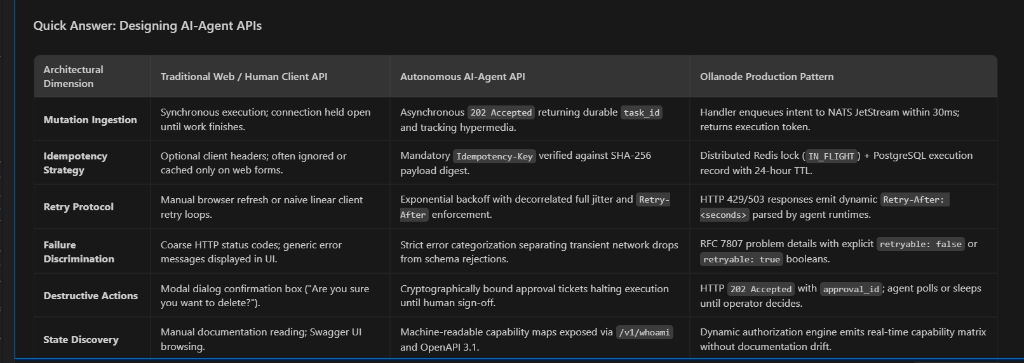
| Architectural Dimension | Traditional Web / Human Client API | Autonomous AI-Agent API | Ollanode Production Pattern |
|---|---|---|---|
| Mutation Ingestion | Synchronous execution; connection held open until work finishes. | Asynchronous 202 Accepted returning durable task_id and tracking hypermedia. | Handler enqueues intent to NATS JetStream within 30ms; returns execution token. |
| Idempotency Strategy | Optional client headers; often ignored or cached only on web forms. | Mandatory Idempotency-Key verified against SHA-256 payload digest. | Distributed Redis lock (IN_FLIGHT) + PostgreSQL execution record with 24-hour TTL. |
| Retry Protocol | Manual browser refresh or naive linear client retry loops. | Exponential backoff with decorrelated full jitter and Retry-After enforcement. | HTTP 429/503 responses emit dynamic Retry-After: <seconds> parsed by agent runtimes. |
| Failure Discrimination | Coarse HTTP status codes; generic error messages displayed in UI. | Strict error categorization separating transient network drops from schema rejections. | RFC 7807 problem details with explicit retryable: false or retryable: true booleans. |
| Destructive Actions | Modal dialog confirmation box (“Are you sure you want to delete?”). | Cryptographically bound approval tickets halting execution until human sign-off. | HTTP 202 Accepted with approval_id; agent polls or sleeps until operator decides. |
| State Discovery | Manual documentation reading; Swagger UI browsing. | Machine-readable capability maps exposed via /v1/whoami and OpenAPI 3.1. | Dynamic authorization engine emits real-time capability matrix without documentation drift. |
Designing an agent-safe API requires turning mutating endpoints into lease-governed state machines. The gateway must ingest intent instantly, reject duplicate conflicting calls before allocating compute resources, offload execution to durable worker queues, and offer deterministic polling endpoints that prevent agents from exhausting context tokens.
KEY TAKEAWAYS
- Stochastic clients require deterministic gateways: LLM agents are inherently probabilistic. API gateways must enforce determinism through distributed idempotency leases, payload fingerprinting, and transactional state machines.
- Payload binding prevents subtle drift: Storing an idempotency key alone is insufficient. Gateways must hash the request body using SHA-256. If an agent sends an existing key with altered parameters, the API must reject the request with HTTP 422 Unprocessable Entity.
- Never perform mutations synchronously: Operations taking longer than 500 milliseconds must return HTTP 202 Accepted with a status URL, estimated completion time, and unique task token.
- Jittered backoff is mandatory: Autonomous agent swarms trigger severe thundering herds during upstream degradation. Client runtimes must implement decorrelated full jitter to prevent catastrophic system collapse.
- Human-in-the-loop demands suspended execution: High-blast-radius actions (resource deletion, DNS modifications, edge script deployments) must pause in a pending approval state, returning a 202 token until an administrator approves the action.
- Capability discovery eliminates hallucinations: Exposing a machine-readable
/v1/whoamicapability map allows agents to inspect authorized actions and parameter limits dynamically before dispatching invalid requests. - Tamper-evident audit logs establish legal attribution: Every tool call must be appended to an immutable cryptographic ledger linking the agent's key, payload digest, and administrative approval signatures.
1. Problem Statement: Why AI Agents Break Traditional Web API Semantics
When software engineers build APIs for human users, they rely on intuitive safeguards. If a network disruption occurs during checkout, the browser displays an error. The user checks their account history before clicking submit again. If a service remains down, the user stops and seeks assistance.
Autonomous AI agents do not possess human caution. Inside an autonomous loop, an agent pursues goals through continuous tool execution. When an API call times out, the agent determines its next action through probabilistic token generation. This creates three critical vulnerabilities in standard REST architectures:
First, agents generate stochastic retry storms. When an agent initiates an asset creation call on Ollanode and the reverse proxy times out after 30 seconds with an HTTP 504, the agent’s context receives an unformatted connection drop. The model’s subsequent reasoning pass often determines the operation failed to register, immediately repeating the tool call. Across an agent swarm, this creates self-inflicted denial-of-service waves.
Second, agents trigger hallucinated argument drift. During retries, models frequently attempt to resolve errors by modifying secondary arguments. If an agent calling POST /v1/videos encounters a timeout, it might infer that an argument like "quality_preset": "high" was invalid and resend the request with "quality_preset": "standard". If the server verifies idempotency using only a key header without checking body contents, it silently serves the cached result of the original call, desynchronizing client context from server reality.
Third, agents cause cascading resource leaks. Complex workflows require multi-step tool sequences: creating records, minting presigned upload links, transferring data, and scheduling compute. If a connection fails on step four, the agent frequently abandons the sequence and starts over from step one. Without automated lease expirations and garbage collection, backend infrastructure accumulates abandoned records, stranded storage objects, and wasted compute allocations.
2. A Short History: From Human-Driven Browsers to Autonomous Machine Callers
Examining the evolution of client models reveals why API contracts must adapt to machine actors:
Era 1: The Human-Driven Web (1995–2010)
Web services served human-operated desktop browsers. Concurrency was modest, and multi-second latencies were tolerated. Double-submission bugs were handled via basic frontend button states or database unique constraints. When errors occurred, human judgment governed recovery.
Era 2: Mobile Devices and Microservices (2010–2023)
Mobile networks introduced frequent cellular drops and application lifecycle interruptions. Engineering teams adopted Stripe-style Idempotency-Key headers for payment mutations, implemented exponential backoff in official SDKs, and offloaded heavy processing to background workers. Crucially, client logic remained deterministic code authored by human engineers.
Era 3: Autonomous Machine Actors (2024–Present)
Function calling, OpenAI Assistants, and the Model Context Protocol (MCP) established LLMs as primary API consumers. In this era, clients generate payloads dynamically, run autonomously in headless execution loops, and interpret JSON responses through probabilistic inference.
The client is no longer a static binary; it is an autonomous agent reacting unpredictably to latency, rate limits, and ambiguous errors. Infrastructure platforms like Ollanode were designed specifically for this reality, embedding transactional leases, payload hashing, and human approval gates directly into the API control plane.
3. Core Definitions: Idempotency, Safe Retries, and Asynchronous Execution
Establishing rigorous mathematical and operational definitions prevents architectural ambiguity:
Idempotency
An API operation is idempotent if dispatching multiple identical requests produces the exact same side-effect on system state as dispatching a single request.
Formally, if a system mutation is expressed as a state transition function:
$$f: S \times R \rightarrow S’ \times M$$
where $S$ is the initial system state, $R$ is the request payload, $S’$ is the modified system state, and $M$ is the emitted response, the operation is idempotent if and only if:
$$f(f(S, R), R) = f(S, R)$$
While RFC 7231 specifies HTTP GET, HEAD, PUT, and DELETE as idempotent by definition, real-world implementations frequently diverge. In agent-safe APIs, all mutating methods—including POST and PATCH—must be made strictly idempotent via transaction tokens.
Safe Retries
A retry is safe when an autonomous client can re-transmit a failed or interrupted request over the network with mathematical certainty that:
- The backend will execute the underlying business logic exactly once.
- The server will return the cached response if the initial execution succeeded.
- The server will signal an active lock if the operation is currently processing.
- The client will not amplify downstream infrastructure failures.
Asynchronous Execution
An asynchronous workflow decouples the HTTP network connection from computational execution. The API gateway validates payload schemas, secures an idempotency lease, commits task intent to a durable log, and immediately returns HTTP 202 Accepted with a tracking identifier and status hypermedia. The client monitors progress via polling, server-sent events, or registered webhooks.
4. Architecture: The Four Pillars of Agent-Resilient API Gateways
Building a backend capable of safely handling autonomous AI agents requires organizing infrastructure into four distinct functional layers:
Pillar 1: Ingress & Payload Fingerprinting
The ingress edge terminates TLS, authenticates agent credentials via Argon2id token caches, enforces rate limits, and inspects headers for a mandatory Idempotency-Key. It computes a SHA-256 hash of the incoming request body. If the idempotency header is missing on a mutating endpoint, the gateway rejects the request before it reaches downstream application code.
Pillar 2: Distributed Concurrency & Lease Engine
The lease engine acts as an atomic concurrency barrier across the cluster. Typically backed by a Redis cluster, it tracks each idempotency key through three lifecycle states: IN_FLIGHT, COMPLETED, or FAILED. It prevents race conditions when an agent dispatches duplicate concurrent requests with the same key.
Pillar 3: Durable Event Dispatcher
The API gateway never executes long-running business logic directly on the web server thread. Instead, it publishes an immutable task intent message to a distributed log (such as NATS JetStream, Apache Kafka, or a transactional PostgreSQL outbox). Decoupled worker pools consume tasks from this queue, ensuring that gateway restarts never cause dropped jobs.
Pillar 4: Capability & Governance Layer
Because autonomous agents operate within least-privilege boundaries, the platform evaluates every request against a dynamic capability engine. Destructive or high-blast-radius operations (such as deleting video libraries, reconfiguring DNS apex records, or modifying CDN routing) trigger a suspended approval state. The API halts execution, returns an HTTP 202 containing an approval_id, and notifies human administrators. For more details on governance, see our guide on AI Agent Infrastructure Control: APIs, Capabilities, and Approval Gates.
5. Internal Working: Synchronous Request Path vs Asynchronous Job Path
To maintain high availability and sub-50ms gateway response times, agent-facing architectures split operations into two separate execution paths:
The Synchronous Request Path (< 30ms Budget):
- Header Validation: Ingress confirms presence of
Authorization: Bearer <token>andIdempotency-Key: <uuid>. - Body Fingerprinting: The raw request body is read into memory and hashed using SHA-256.
- Lease Acquisition: The gateway executes an atomic
SET NX EXcommand in Redis foridemp:{project_id}:{key}.- If the key exists with status
COMPLETED, the gateway immediately serves the cached HTTP status code, headers, and JSON body. - If the key exists with status
IN_FLIGHT, the gateway immediately returns HTTP 409 Conflict with aRetry-After: 5header. - If the key is new, the lease is granted with status
IN_FLIGHTand a 60-second lease timeout.
- If the key exists with status
- Digest Validation: If persistent records exist, the incoming body hash is compared against the stored hash. Any discrepancy returns HTTP 422 Unprocessable Entity.
- Durable Intent Enqueue: The task intent is committed to PostgreSQL and published to NATS JetStream.
- Immediate Response: The gateway returns HTTP 202 Accepted with a task identifier and polling URI.
The Asynchronous Job Path (Seconds to Minutes):
- Worker Claim: An isolated background worker claims the task from the NATS JetStream subject.
- Execution: The worker performs the mutation (e.g., executing FFmpeg transcoding, generating HLS manifests, resizing images).
- Relational Update: The final state and asset metadata are committed to the primary PostgreSQL database.
- Lease Finalization: The Redis record transitions from
IN_FLIGHTtoCOMPLETED, caching the final response payload with a 24-hour TTL. - Webhook Dispatch: An HMAC-signed event notification is dispatched to registered agent callback URLs.
6. Deep Dive: Deterministic Idempotency Keys and Payload Fingerprinting
Standard idempotency implementations check only the Idempotency-Key header. In autonomous agent environments, this creates a dangerous failure mode called argument drift: when a network timeout occurs, an LLM frequently attempts to “fix” the error on retry by mutating optional parameters while reusing the same key.
If the server checks only the key, it silently serves the cached result of the original request, causing client context and server state to diverge.
The Solution: Cryptographic Digest Binding
Gateways must bind every idempotency record to the SHA-256 hash of the raw request body:
{
  "idempotency_key": "8a4b2c1d-7e8f-4a3b-9c2d-1e0f8a7b6c5d",
  "payload_sha256": "e3b0c44298fc1c149afbf4c8996fb92427ae41e4649b934ca495991b7852b855",
  "status": "COMPLETED",
  "response_status_code": 202
}
The Rejection Protocol: HTTP 422 Unprocessable Entity
If an agent submits an existing key with altered parameters, the gateway immediately halts execution:
HTTP/1.1 422 Unprocessable Entity
Content-Type: application/problem+json

{
  "code": "IDEMPOTENCY_PAYLOAD_MISMATCH",
  "detail": "Idempotency-Key was previously used with a different payload. Parameter modification during retry is rejected.",
  "retryable": false
}
7. Deep Dive: Safe Retry Protocols, Decorrelated Jitter, and Error Signaling
When an API client is an autonomous agent, retry logic cannot be left to prompt-based heuristics. The server must provide explicit error classification and enforce mathematical backoff rules.
Error Classification Matrix
| HTTP Status Code | Classification | Agent Behavior | Retryable? | Gateway Strategy |
|---|---|---|---|---|
| 400 Bad Request | Permanent Schema Error | Abort; update arguments | No | Return explicit field-level validation errors. |
| 401 Unauthorized | Permanent Auth Failure | Abort; request key rotation | No | Reject immediately. Key is invalid or expired. |
| 403 Forbidden | Permanent Scope Error | Abort; query /v1/whoami | No | Do not retry. Caller lacks required permission scope. |
| 404 Not Found | Permanent Resource Error | Abort; check resource ID | No | Confirm resource existence before repeating. |
| 409 Conflict | Concurrency Lock | Wait and retry with backoff | Yes | Active lease in progress; return Retry-After: 5. |
| 422 Unprocessable Entity | Semantic Validation Failure | Abort; payload drifted | No | Reject key reuse with altered request body. |
| 429 Too Many Requests | Rate Limit Exhausted | Wait and retry with jitter | Yes | Emit exact Retry-After: <seconds> header. |
| 500 Internal Server Error | Ambiguous Server Bug | Retry with strict budget | Conditional | Allow max 2 retries; log error to telemetry. |
| 502 Bad Gateway | Transient Network Proxy Drop | Retry with standard backoff | Yes | Upstream node restarting; safe to retry. |
| 503 Service Unavailable | Transient Cluster Overload | Retry respecting headers | Yes | Platform under backpressure; honor Retry-After. |
| 504 Gateway Timeout | Ambiguous Socket Timeout | Retry with same key | Yes | Operation may have succeeded; replay key. |
8. Deep Dive: The 202 Accepted Asynchronous Task Pattern
Long-running computational jobs (such as video transcoding or transcription) must never block synchronous HTTP sockets. Holding connections open risks 504 timeouts at reverse proxies and triggers duplicate agent retries. Instead, APIs decouple ingestion from execution using a clean three-phase handshake:
# 1. Intent Submission -> Instant 202 Handshake
POST /v1/videos/vid_01/transcode HTTP/1.1
Idempotency-Key: 8a4b2c1d-7e8f-4a3b-9c2d-1e0f8a7b6c5d
Content-Type: application/json

{"renditions": ["1080p", "720p"]}

HTTP/1.1 202 Accepted
Location: /v1/tasks/tsk_99
Content-Type: application/json

{"task_id": "tsk_99", "status": "processing", "poll_interval_seconds": 5, "status_url": "/v1/tasks/tsk_99"}

# 2. Lightweight Status Polling (Preserves Context Window)
GET /v1/tasks/tsk_99 HTTP/1.1

HTTP/1.1 200 OK
Content-Type: application/json

{"task_id": "tsk_99", "status": "processing", "progress_percentage": 68}

# 3. Terminal State Delivery
GET /v1/tasks/tsk_99 HTTP/1.1

HTTP/1.1 200 OK
Content-Type: application/json

{"task_id": "tsk_99", "status": "ready", "result": {"playback_url": "https://play.ollanode.com/v1/vid_01/manifest.m3u8"}}
Why This Protects Autonomous Agents
- Prevents Socket Drops: The gateway responds within milliseconds, enqueuing work to NATS JetStream without hitting proxy timeouts.
- Saves Context Window Tokens: The polling endpoint returns compact progress JSON, ensuring agents do not exhaust LLM memory during long background jobs.
- Guides Agent Cadence: The
"poll_interval_seconds": 5field instructs the agent’s sleep loop programmatically, preventing aggressive query floods.
9. Deep Dive: Human-in-the-Loop Approval Gates (The 202 Approval Protocol)
When an autonomous agent has access to core infrastructure, high-blast-radius operations cannot be executed unsupervised:
- Deleting an object storage zone (
storage:delete) - Modifying production DNS apex records (
dns:write) - Deploying arbitrary edge compute code (
functions:write) - Deleting entire media catalogs (
videos:delete)
Ollanode implements a formal protocol for these scenarios: The 202 Approval Protocol.
The Wire Protocol Mechanics
- Agent Dispatches Destructive Action: An agent key calls an approval-gated endpoint:
DELETE /v1/videos/vid_01jk98az HTTP/1.1
Host: api.ollanode.com
Authorization: Bearer vbk_agent_44aa...
Idempotency-Key: idemp_del_9011
- Server Evaluates Role & Scope: The gateway observes that the authenticated key has role
agent, for whichvideos:deleteis configured asapproval_required. - Approval Record Generated: The gateway creates a persistent approval record capturing the unique
approval_id, request path, method, headers, SHA-256 body hash, and expiration timestamp. - Server Suspends Request with HTTP 202:
HTTP/1.1 202 Accepted
Content-Type: application/json

{
  "status": "pending_approval",
  "approval_id": "appr_7718aa09",
  "message": "This operation requires human administrator approval. Execution suspended.",
  "action": "videos:delete",
  "resource_id": "vid_01jk98az",
  "check_status_url": "/v1/approvals/appr_7718aa09"
}
- Operator Approves: An administrator reviews the request in the Ollanode dashboard and authorizes the action via
POST /v1/approvals/appr_7718aa09/decide. - Agent Replays with Approval Header: The agent re-submits the exact original request, attaching the
X-Approval-Id: appr_7718aa09header. - Digest Verification & Execution: The gateway verifies that the approval token is valid, confirms that the payload digest matches the original request byte-for-byte, and executes the deletion immediately.
10. Deep Dive: Outbound Webhook Delivery and Cryptographic Receipts
For long-running tasks lasting hours, continuous polling is inefficient. Asynchronous event callbacks allow agent runtimes to suspend execution and resume upon notification.
Outbound Webhook Headers
Every webhook sent by Ollanode includes three cryptographic headers:
POST /agent-webhook-receiver HTTP/1.1
Host: agent.enterprise.internal
Content-Type: application/json
X-VB-Delivery-Id: del_01jk989a81
X-VB-Event: video.processing.ready
X-VB-Signature: sha256=d3b07384d113edec49eaa6238ad5ff00da7b949ba3f...
The signature is computed over the raw payload:
$$\text{Signature} = \text{HMAC-SHA256}(\text{Secret}, \text{RawJSONBody})$$
Delivery Retry Backoff Schedule
If an agent webhook receiver crashes or restarts, the dispatcher uses an exponential backoff schedule across 7 attempts:
| Delivery Attempt | Delay After Previous Attempt | Cumulative Elapsed Time |
|---|---|---|
| Attempt 1 | Immediate (0s) | 0 seconds |
| Attempt 2 | 10 seconds | 10 seconds |
| Attempt 3 | 30 seconds | 40 seconds |
| Attempt 4 | 2 minutes (120s) | 2 minutes, 40 seconds |
| Attempt 5 | 10 minutes (600s) | 12 minutes, 40 seconds |
| Attempt 6 | 30 minutes (1,800s) | 42 minutes, 40 seconds |
| Attempt 7 | 2 hours (7,200s) | 2 hours, 42 minutes |
If all attempts fail, the event is routed to a Dead Letter Queue (DLQ), where operators can inspect logs and trigger manual redelivery once the agent server recovers.
11. Production Contract: Machine-Readable OpenAPI 3.1 Specification
AI agents assemble tool calls directly from machine-readable schemas. An agent-safe contract must explicitly declare three primitives: a required Idempotency-Key header, an async 202 Accepted response with status URLs, and RFC 7807 error codes with retryable flags.
openapi: 3.1.0
paths:
  /v1/videos:
    post:
      summary: Create asset (Idempotent & Async)
      headers:
        Idempotency-Key:
          schema: { type: string, format: uuid }
          required: true
      responses:
        '202':
          description: Accepted for async processing
          headers: { Location: { schema: { type: string } } }
          content:
            application/json:
              schema:
                required: [task_id, status_url]
                properties:
                  task_id: { type: string }
                  status_url: { type: string, format: uri }
                  poll_interval_seconds: { type: integer, default: 5 }
        '409':
          description: In-flight execution lock
          headers: { Retry-After: { schema: { type: integer } } }
        '422':
          description: Payload drift rejected
          content:
            application/problem+json:
              schema:
                properties:
                  code: { type: string, example: "IDEMPOTENCY_PAYLOAD_MISMATCH" }
                  retryable: { type: boolean, example: false }
12. Server-Side Implementation: Production Rust & Axum Idempotency Middleware
This middleware intercepts mutating requests, hashes the raw body with SHA-256, and uses Redis atomic leases to prevent concurrent execution while caching successful responses for replay.
pub async fn idempotency_middleware(
    State(state): State<Arc<AppState>>, headers: HeaderMap, req: Request<Body>, next: Next,
) -> Result<Response<Body>, (StatusCode, Json<Value>)> {
    if req.method() == "GET" || req.method() == "HEAD" { return Ok(next.run(req).await); }

    let key = headers.get("Idempotency-Key").and_then(|v| v.to_str().ok())
        .ok_or((StatusCode::BAD_REQUEST, Json(json!({"error": "MISSING_IDEMPOTENCY_KEY"}))))?;

    // 1. Hash incoming payload
    let (parts, body) = req.into_parts();
    let bytes = to_bytes(body, 10 * 1024 * 1024).await.unwrap_or_default();
    let hash = format!("{:x}", Sha256::digest(&bytes));
    let redis_key = format!("idemp:{key}");

    // 2. Check lease or replay completed response
    if let Ok(Some(cached)) = state.redis.clone().get::<_, Option<String>>(&redis_key).await {
        let rec: IdempotencyRecord = serde_json::from_str(&cached).unwrap();
        if rec.payload_hash != hash { return Err((StatusCode::UNPROCESSABLE_ENTITY, Json(json!({"error": "PAYLOAD_MISMATCH"})))); }
        if rec.status == "IN_FLIGHT" { return Err((StatusCode::CONFLICT, Json(json!({"error": "IN_FLIGHT", "retry_after": 5})))); }
        return Ok(Response::builder().status(rec.status_code).body(Body::from(rec.body)).unwrap());
    }

    // 3. Acquire atomic lease (60s TTL)
    let in_flight = json!({"payload_hash": hash, "status": "IN_FLIGHT"}).to_string();
    let locked: bool = redis::cmd("SET").arg(&redis_key).arg(&in_flight).arg("NX").arg("EX").arg(60)
        .query_async(&mut state.redis.clone()).await.unwrap_or(false);
    if !locked { return Err((StatusCode::CONFLICT, Json(json!({"error": "LOCK_COLLISION"})))); }

    // 4. Execute handler and cache result for 24h
    let res = next.run(Request::from_parts(parts, Body::from(bytes))).await;
    let (res_parts, res_body) = res.into_parts();
    let res_bytes = to_bytes(res_body, 10 * 1024 * 1024).await.unwrap_or_default();

    let completed = json!({"payload_hash": hash, "status": "COMPLETED", "status_code": res_parts.status.as_u16(), "body": String::from_utf8_lossy(&res_bytes)}).to_string();
    let _: () = state.redis.clone().set_ex(&redis_key, completed, 86400).await.unwrap_or_default();

    Ok(Response::from_parts(res_parts, Body::from(res_bytes)))
}
13. Client-Side Implementation: Production Python Agent Client with Safe Retries
This middleware intercepts mutating requests, hashes the raw body, and uses atomic Redis leases to prevent concurrent runs while replaying cached responses.
pub async fn idempotency_middleware(
    state: State<Arc<AppState>>, headers: HeaderMap, req: Request<Body>, next: Next,
) -> Result<Response<Body>, (StatusCode, Json<Value>)> {
    if req.method() == "GET" || req.method() == "HEAD" { return Ok(next.run(req).await); }

    let key = headers.get("Idempotency-Key").and_then(|v| v.to_str().ok())
        .ok_or((StatusCode::BAD_REQUEST, Json(json!({"error": "MISSING_IDEMPOTENCY_KEY"}))))?;

    // 1. Hash request body
    let (parts, body) = req.into_parts();
    let bytes = to_bytes(body, 10 * 1024 * 1024).await.unwrap_or_default();
    let hash = format!("{:x}", Sha256::digest(&bytes));
    let redis_key = format!("idemp:{key}");

    // 2. Check lease / replay cached response
    if let Ok(Some(cached)) = state.redis.clone().get::<_, Option<String>>(&redis_key).await {
        let rec: IdempotencyRecord = serde_json::from_str(&cached).unwrap();
        if rec.payload_hash != hash { return Err((StatusCode::UNPROCESSABLE_ENTITY, Json(json!({"error": "PAYLOAD_MISMATCH"})))); }
        if rec.status == "IN_FLIGHT" { return Err((StatusCode::CONFLICT, Json(json!({"error": "IN_FLIGHT", "retry_after": 5})))); }
        return Ok(Response::builder().status(rec.status_code).body(Body::from(rec.body)).unwrap());
    }

    // 3. Acquire atomic lease (60s TTL)
    let lock_val = json!({"payload_hash": hash, "status": "IN_FLIGHT"}).to_string();
    let acquired: bool = redis::cmd("SET").arg(&redis_key).arg(&lock_val).arg("NX").arg("EX").arg(60)
        .query_async(&mut state.redis.clone()).await.unwrap_or(false);
    if !acquired { return Err((StatusCode::CONFLICT, Json(json!({"error": "LOCK_COLLISION"})))); }

    // 4. Execute & cache response for 24 hours
    let res = next.run(Request::from_parts(parts, Body::from(bytes))).await;
    let (res_parts, res_body) = res.into_parts();
    let res_bytes = to_bytes(res_body, 10 * 1024 * 1024).await.unwrap_or_default();

    let completed = json!({"payload_hash": hash, "status": "COMPLETED", "status_code": res_parts.status.as_u16(), "body": String::from_utf8_lossy(&res_bytes)}).to_string();
    let _: () = state.redis.clone().set_ex(&redis_key, completed, 86400).await.unwrap_or_default();

    Ok(Response::from_parts(res_parts, Body::from(res_bytes)))
}
14. Concurrency & State: Redis Distributed Leases vs PostgreSQL Durability
Balancing write latency against strict durability requires a two-tier storage model:
| Architectural Property | Redis (In-Memory Lease Tier) | PostgreSQL (Durable Ledger Tier) | Ollanode Hybrid Architecture |
|---|---|---|---|
| Write Latency | < 1 millisecond | 5–15 milliseconds | < 1ms on ingress path |
| Consistency Model | Eventual consistency across replicas | Strict ACID serializability | Multi-tier consistency |
| Durability Guarantee | In-memory with AOF disk snapshots | Write-Ahead Log (WAL) to disk | Zero loss of completed jobs |
| Concurrency Lock | Atomic SET NX EX | Row-level FOR UPDATE locks | Redis lease + Postgres lock |
| Primary Responsibility | Ingress deduplication & caching | Permanent task audit & history | Optimal performance and safety |
The Two-Tier Strategy in Practice
- Tier 1 (Redis): Ingress microservices acquire an atomic 60-second lease using
SET NX EX. This absorbs rapid retry waves without querying relational disks. - Tier 2 (PostgreSQL): Once business logic executes, the final state is committed to a permanent
idempotency_recordstable with a 24-hour TTL, ensuring auditability and compliance.
15. The Complete State Machine Lifecycle for Agent Mutations
Every mutating operation dispatched by an AI agent moves through a deterministic state machine:
| Current State | Event / Trigger | Next State | System Action | HTTP Status Code |
|---|---|---|---|---|
| Non-Existent | POST with new key | IN_FLIGHT | Acquire Redis lease; publish event to NATS | 202 Accepted |
| Non-Existent | POST without key | Failed | Reject request at ingress | 400 Bad Request |
| IN_FLIGHT | Retry with identical hash | IN_FLIGHT | Signal active execution | 409 Conflict (Retry-After: 5) |
| IN_FLIGHT | Retry with drifted hash | FAILED | Invalidate lease; flag error | 422 Unprocessable Entity |
| IN_FLIGHT | Policy detects gated scope | PENDING_APPROVAL | Suspend task; create approval_id | 202 Accepted (approval_id) |
| IN_FLIGHT | Worker finishes task | COMPLETED | Cache final response in Redis & DB | Internal State Shift |
| PENDING_APPROVAL | Admin approves action | PROCESSING | Worker resumes job execution | Internal State Shift |
| PENDING_APPROVAL | Admin rejects action | REJECTED | Mark terminal rejection | 403 Forbidden on poll |
| COMPLETED | Replay with matching hash | COMPLETED | Serve cached response from Redis | 200 OK / 202 Accepted |
| COMPLETED | Replay with drifted hash | COMPLETED | Guard against parameter drift | 422 Unprocessable Entity |
16. Production Failure Modes: Post-Mortems from the Field
Operating AI-agent control planes in production reveals edge cases that do not occur in traditional web environments:
Case 1: The Infinite Polling Context Overflow
- Failure: An agent triggered a video transcoding job and polled the status endpoint every 400 milliseconds.
- Impact: The resulting JSON responses rapidly consumed the agent’s context window. The agent forgot its initial system prompt, inferred that the task had hung, and spawned a duplicate transcoding job with a new key.
- Resolution: Enforced dynamic rate limits on status endpoints, injected
"poll_interval_seconds": 5into responses, and updated client SDKs to enforce mandatory polling sleeps.
Case 2: The Double-Delete Race Condition
- Failure: Two autonomous sub-agents concurrently attempted to clean up temporary video files, calling
DELETE /v1/videos/vid_091aat the exact same millisecond. - Impact: The first call succeeded, deleting the database row. The second call triggered an unhandled 500 Internal Server Error because the record vanished mid-transaction. The agent interpreted the 500 error as an infrastructure crash and retried indefinitely.
- Resolution: Made deletion operations strictly idempotent. Deleting an already-deleted resource now cleanly returns 204 No Content with
"retryable": false.
Case 3: The Header Mutation Ghost Lock
- Failure: An agent framework inserted a dynamic timestamp header inside the JSON body on automatic retries.
- Impact: The SHA-256 payload digest changed between attempts, causing the gateway to reject retries with 422 Unprocessable Entity. Because the agent had no handler for 422 errors, it hung indefinitely.
- Resolution: Implemented body normalization to strip volatile debugging fields and return actionable error details explaining parameter drift.
17. Security & Governance: Capability Maps, Scopes, and Operator Kill Switches
Autonomous agent security requires three interconnected defensive barriers:
1. Granular Scope Enclaves
Never issue blanket admin keys to automated agents. Restrict credentials to narrow scopes:
- Permitted:
videos:read,videos:write,storage:read - Approval Gated:
videos:delete,zones:purge,dns:write - Permanently Denied:
keys:*,billing:*,team:*
2. Live Capability Discovery via /v1/whoami
Agents frequently make invalid assumptions about their permissions. Providing a machine-readable capability endpoint prevents unauthorized API calls before they happen:
GET /v1/whoami HTTP/1.1
Host: api.ollanode.com
Authorization: Bearer vbk_agent_88aa01...

HTTP/1.1 200 OK
Content-Type: application/json

{
  "project_id": "proj_9021a",
  "role": "agent",
  "capabilities": {
    "videos:create": "allowed",
    "videos:read": "allowed",
    "videos:delete": "approval_required",
    "dns:modify": "denied"
  },
  "rate_limits": {
    "requests_per_minute": 120
  }
}
3. Emergency Operator Kill Switches
When an agent suffers prompt injection or enters an infinite loop, operators must be able to sever its access instantly. Ollanode provides emergency kill switch endpoints that immediately revoke agent credentials, purge active Redis leases, and cancel in-flight worker tasks across the cluster. For architectural details on audit ledgers and kill switches, see our guide on AI Agent Observability: What to Log, Audit, and Alert On.
18. Latency & Performance Budgets for Autonomous Agent Tool Loops
Because multi-step agent reasoning chains require sequential tool invocations, API gateway latency directly impacts operational costs and user experience:
| Pipeline Stage | Target Latency Budget | Implementation Strategy |
|---|---|---|
| TLS Termination & Ingress | < 10ms | Edge termination via OpenResty / Cloudflare |
| Authentication & Auth Check | < 5ms | In-memory token hashing via Argon2id caches |
| Idempotency Lease Check | < 2ms | Redis SET NX EX in local datacenter |
| Task Queue Publishing | < 5ms | Asynchronous append to NATS JetStream stream |
| Total Synchronous Budget | < 22ms | Gateway immediately returns 202 Accepted |
| Status Poll Latency | < 15ms | Read-replica database queries or KV cache |
Maintaining sub-30ms response times at the gateway prevents agent connection timeouts and allows reasoning loops to proceed immediately to subsequent tasks.
19. Troubleshooting Reference: Error Codes, Headers, and Diagnostic Playbooks
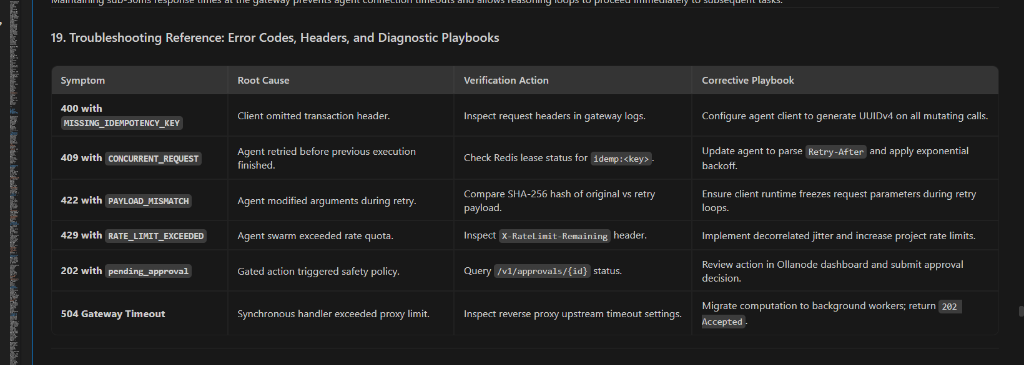
| Symptom | Root Cause | Verification Action | Corrective Playbook |
|---|---|---|---|
400 with MISSING_IDEMPOTENCY_KEY | Client omitted transaction header. | Inspect request headers in gateway logs. | Configure agent client to generate UUIDv4 on all mutating calls. |
409 with CONCURRENT_REQUEST | Agent retried before previous execution finished. | Check Redis lease status for idemp:<key>. | Update agent to parse Retry-After and apply exponential backoff. |
422 with PAYLOAD_MISMATCH | Agent modified arguments during retry. | Compare SHA-256 hash of original vs retry payload. | Ensure client runtime freezes request parameters during retry loops. |
429 with RATE_LIMIT_EXCEEDED | Agent swarm exceeded rate quota. | Inspect X-RateLimit-Remaining header. | Implement decorrelated jitter and increase project rate limits. |
202 with pending_approval | Gated action triggered safety policy. | Query /v1/approvals/{id} status. | Review action in Ollanode dashboard and submit approval decision. |
504 Gateway Timeout | Synchronous handler exceeded proxy limit. | Inspect reverse proxy upstream timeout settings. | Migrate computation to background workers; return 202 Accepted. |
20. Operational Checklist: Production Readiness for AI Agent APIs
- Mandatory Idempotency: Require
Idempotency-Keyheaders on all POST, PUT, PATCH, and DELETE requests. - Payload Hashing: Bind idempotency records to the SHA-256 digest of the request body.
- Asynchronous Decoupling: Return HTTP 202 Accepted on all operations exceeding 500ms.
- Jittered Backoff: Enforce decorrelated full jitter algorithms in all client SDKs.
- Approval Gating: Route destructive operations through a suspended 202 approval state.
- Capability Discovery: Expose dynamic permission maps via
/v1/whoami. - Emergency Kill Switch: Implement instantaneous credential revocation for autonomous agents.
- Cryptographic Auditability: Maintain append-only, tamper-evident hash-chained logs of all agent tool calls.
21. Common Anti-Patterns: Critical Pitfalls in Agent API Engineering
Pitfall 1: Synchronous Heavy Computation
Executing media encoding, document parsing, or batch deletions directly on the HTTP web thread guarantees reverse proxy timeouts, dropped sockets, and duplicate agent retries.
Pitfall 2: Key-Only Idempotency Validation
Failing to verify the SHA-256 hash of incoming payloads allows agents with hallucinated parameter drift to receive cached responses that directly contradict their updated instructions.
Pitfall 3: Unbounded Status Polling
Permitting agents to poll status endpoints without enforced intervals or rate limits rapidly exhausts context windows and overloads database read replicas.
22. Protocol Comparison: REST vs Webhooks vs Async Task APIs vs MCP
| Dimension | Standard REST (Synchronous) | Async Task API (202 Polling) | Webhook Callbacks | Model Context Protocol (MCP) |
|---|---|---|---|---|
| Primary Use Case | Fast data queries (< 50ms) | Long-running mutations | Asynchronous event alerts | Desktop & LLM tool integration |
| Socket Duration | Open until work finishes | Instant close; client polls | Instant close; server calls back | Persistent JSON-RPC stream |
| Network Failure Safety | Low (vulnerable to drops) | High (immune to drops) | Moderate (requires public receiver) | High (session-scoped tool calls) |
| Human Approval Fit | Poor (connection times out) | Native (via 202 Approval) | Moderate (callback triggered) | Native (via sampling & approval) |
| Context Token Cost | Low | Low (compact status JSON) | Zero until event arrives | Moderate (tool schemas in context) |
23. Deployment Topology: High-Availability Architecture for Enterprise Workloads
Deploying an agent-safe API platform in production requires resilience across every tier:
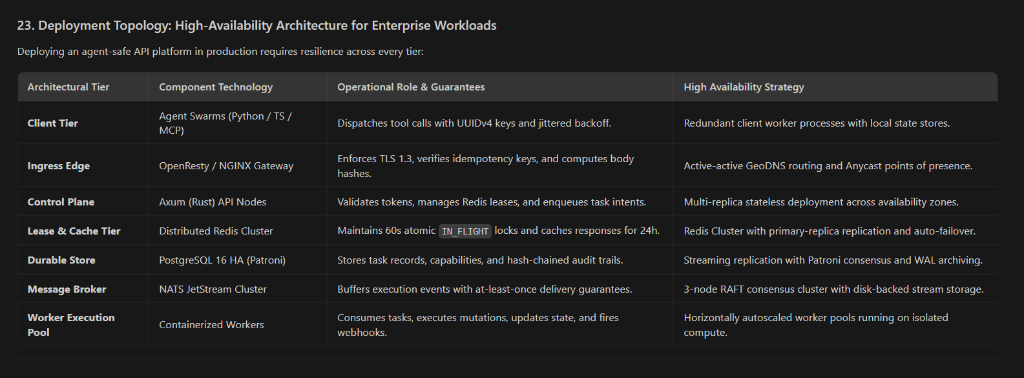
| Architectural Tier | Component Technology | Operational Role & Guarantees | High Availability Strategy |
|---|---|---|---|
| Client Tier | Agent Swarms (Python / TS / MCP) | Dispatches tool calls with UUIDv4 keys and jittered backoff. | Redundant client worker processes with local state stores. |
| Ingress Edge | OpenResty / NGINX Gateway | Enforces TLS 1.3, verifies idempotency keys, and computes body hashes. | Active-active GeoDNS routing and Anycast points of presence. |
| Control Plane | Axum (Rust) API Nodes | Validates tokens, manages Redis leases, and enqueues task intents. | Multi-replica stateless deployment across availability zones. |
| Lease & Cache Tier | Distributed Redis Cluster | Maintains 60s atomic IN_FLIGHT locks and caches responses for 24h. | Redis Cluster with primary-replica replication and auto-failover. |
| Durable Store | PostgreSQL 16 HA (Patroni) | Stores task records, capabilities, and hash-chained audit trails. | Streaming replication with Patroni consensus and WAL archiving. |
| Message Broker | NATS JetStream Cluster | Buffers execution events with at-least-once delivery guarantees. | 3-node RAFT consensus cluster with disk-backed stream storage. |
| Worker Execution Pool | Containerized Workers | Consumes tasks, executes mutations, updates state, and fires webhooks. | Horizontally autoscaled worker pools running on isolated compute. |
24. Frequently Asked Questions
1. Why require an Idempotency-Key on DELETE operations?
While HTTP DELETE is idempotent by specification, deleting an already-deleted resource typically returns HTTP 404 Not Found. When an autonomous agent encounters a 404 error after a connection timeout, it cannot determine whether its prior attempt succeeded or if the target resource never existed. Providing an idempotency key allows the gateway to recognize the retry and return the original successful 204 No Content status.
2. What is the recommended retention window for idempotency keys?
For standard infrastructure operations, a retention window of 24 to 48 hours is optimal. This provides sufficient time for agents to recover from network outages or complete suspended approval workflows without unnecessarily consuming database memory.
3. What is the distinction between HTTP 409 Conflict and HTTP 422 Unprocessable Entity?
HTTP 409 Conflict indicates that a request with the specified idempotency key is currently executing (IN_FLIGHT). The client should wait and retry. HTTP 422 Unprocessable Entity indicates that the key was previously used, but the incoming request payload does not match the stored SHA-256 digest. This represents an unrecoverable semantic error that must not be retried.
4. How can AI agents prevent context token exhaustion during polling?
APIs must provide ultra-compact status responses. Instead of emitting full resource representations on every poll, the status endpoint should return minimal JSON containing only status, progress_percentage, and current_stage. Only upon reaching ready should the complete resource payload be served.
5. Why should APIs avoid generic HTTP 500 Internal Server Errors for agents?
Autonomous agents cannot debug generic 500 errors. An unstructured 500 response frequently causes the LLM to hallucinate incorrect assumptions about why the call failed, leading to parameter corruption or rapid retry loops. Using RFC 7807 problem details with an explicit "retryable": true|false flag gives the agent clear, actionable instructions.
6. Can an agent bypass an approval gate by generating a new idempotency key?
No. In Ollanode, approval gating is evaluated against the authenticated credentials and the action scope (videos:delete), not the idempotency key. Generating a new key simply produces a new pending approval ticket.
7. How does the Model Context Protocol (MCP) interact with HTTP idempotency?
The Model Context Protocol standardizes tool discovery and execution over JSON-RPC. However, MCP tool implementations must still enforce idempotency at the underlying transport layer to prevent duplicate execution when network connections drop between the host and remote infrastructure.
8. What is the performance overhead of SHA-256 body hashing?
Computing a SHA-256 hash over a standard JSON payload (< 64 KB) takes less than 0.05 milliseconds in modern compiled runtimes like Rust or Go. The safety and correctness guarantees far outweigh the negligible CPU overhead.
25. References & Authoritative Standards
- IETF RFC 7231: Hypertext Transfer Protocol (HTTP/1.1): Semantics and Content. Section 4.2: Idempotent Methods.
- IETF Draft: The Idempotency-Key HTTP Header Field (
draft-ietf-httpapi-idempotency-key-04). - IETF RFC 7807: Problem Details for HTTP APIs.
- Ollanode Documentation: AI Agent Governance & Asynchronous Task Orchestration.
- AWS Architecture Center: Exponential Backoff and Jitter (Marc Brooker, 2015).
- Anthropic: Model Context Protocol (MCP) Specification (2024–2026).
- Stripe Engineering: Designing Robust and Predictable APIs with Idempotency (2017).
26. Operational Conclusion & Next Steps
Transitioning from human-driven web clients to autonomous AI agents requires rethinking API architecture from the ground up. Systems can no longer rely on human intuition to resolve network ambiguity or assume that clients will adhere to rigid retry logic.
Building APIs that autonomous agents can operate safely requires:
- Enforcing mandatory idempotency keys bound to cryptographic payload digests.
- Decoupling execution via asynchronous task queues that return HTTP 202 Accepted within milliseconds.
- Implementing decorrelated jitter backoff to prevent destructive thundering herds.
- Suspending high-blast-radius actions behind human-in-the-loop approval gates.
- Exposing real-time capability maps to eliminate argument and endpoint hallucinations.
Platforms like Ollanode prove that these patterns are not theoretical; they are essential production requirements for any engineering team operating autonomous infrastructure. By building strict determinism into your API contracts today, you ensure that autonomous software can scale your operations safely and reliably.